Preservation Preservation
Distribution
Education
Advisers,
Supports,
Staffs etc.
Archives
FAQ
Mailing List
|
|
 Archives Archives

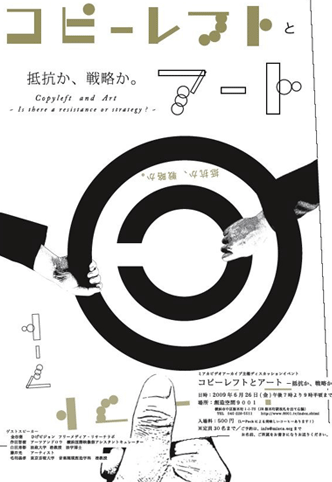
Copyleft and Art -Is there a resistance or strategy?
|
More and more art today is created from remixed or mashed-up digital content such as photo, animation, moving image and music. Nowadays, copyright is an issue for everyone who writes blogs on the internet, is a member of SNS groups such as mixi, facebook and my space, or a user of sites such as flickr, YouTube, NikoNiko Doga and so on.
In the meantime, enhancement of copyright law is a fashion. Lengthening the terms of copyright in Japan is now under discussion.
Intellectual property is important financial resource especially in the west - the US and Europe already have a longer period of copyright. This development may choke a new circulation of creativity. On the other hand, copyright is critical for professional artists.
Copyleft is sometimes misunderstood as being totally against
copyright. Copyleft is rather an attempt to protect the exclusive right of creators while also nurturing emerging creativity.
We would like to go back to the original ideas of Richard Stallman, and to start a discussion between experts and the audience.
-Is copyleft a resistance or can it be a strategy?
-Can we apply copyleft to works of Art, not just software?
-How does copyleft, and the idea of a 'creative commons', help?
-What do those artists who show and distribute their work on
the internet think? Is it effective for their career?
-What is the difference between Public Domain and Copyleft?
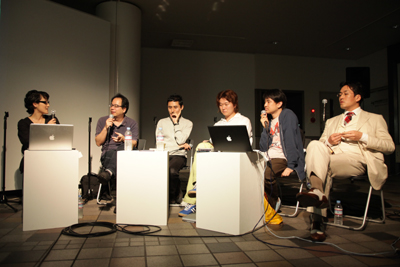
Speakers:
Ken Kanaya : Free culture consumer, Hige Vision, Free Media Research Labo, FAT Tokyo
Tomoki Sakuta: Arts and Law, Curatorial staff of Yokohama
International Festival foe Arts and Media
Hideaki Shirata: Associate Professor of Hose University, Ph.D. of Law
Hikaru Fujii: Artist, activist
Yoshitaka Mouri: Associate Professor of Tokyo University of the Arts
Moderator: Hitomi Hasegawa MIACA Japan
June 26th Fri 2009 7pm~
This time, instead of having everyone come with prepared presentations, we figured everyone already had much to say about copyright,
so we left a lot of time open for free discussion.
We did prepare a few topics, of course, but what really got discussion going was Prof. Shirata's criticism of Creative Commons Japan and the thought behind it. Prof. Mori objected to this criticism, and a real debate ensued - not just the usual harmonious talk. This isn't the kind of thing that can be planned for - it is almost like a chemical reaction that happens when certain people encounter each other. I think we can say that part of the reason this debate happened is that this wasn't just a meeting of familiar associates, but more a case of individuals meeting face-to-face for the first time (as was the case with Prof. Shirata and Prof. Mori).
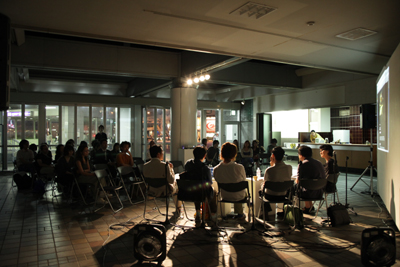
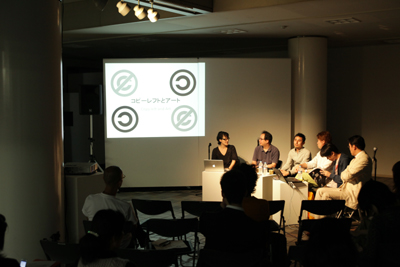 It proved to be a stimulating conversation for everyone in the audience, and even though we went over time there were many questions and comments. Even after the meeting ended, I received e-mails urging us to continue with the discussion. On the topic of copyleft, I particularly wanted to introduce the activities of Richard Stallman, as well as emphasize the way free reproduction and distribution can unexpectedly work to an artist's advantage - but the discussion, I think, shifted to wider, more fundamental issues. Even though copyleft in itself is not a new topic, I think we can consider this event a success for beginning the important debate about copyleft here in Yokohama.
Organized by MIACA Japan
#203, ZAIM Nihon Odori, Nakaku Yokohama Japan
info@miaca.org
www.miaca.org
+81-45-662-0390
+81-80-5004-1657
Supported by Arts Commission Yokohama, Yokohama Art Foundation
Advanced Arts support Fund 2009
 Back Back
|